How NLP automates document processing for Australian enterprises
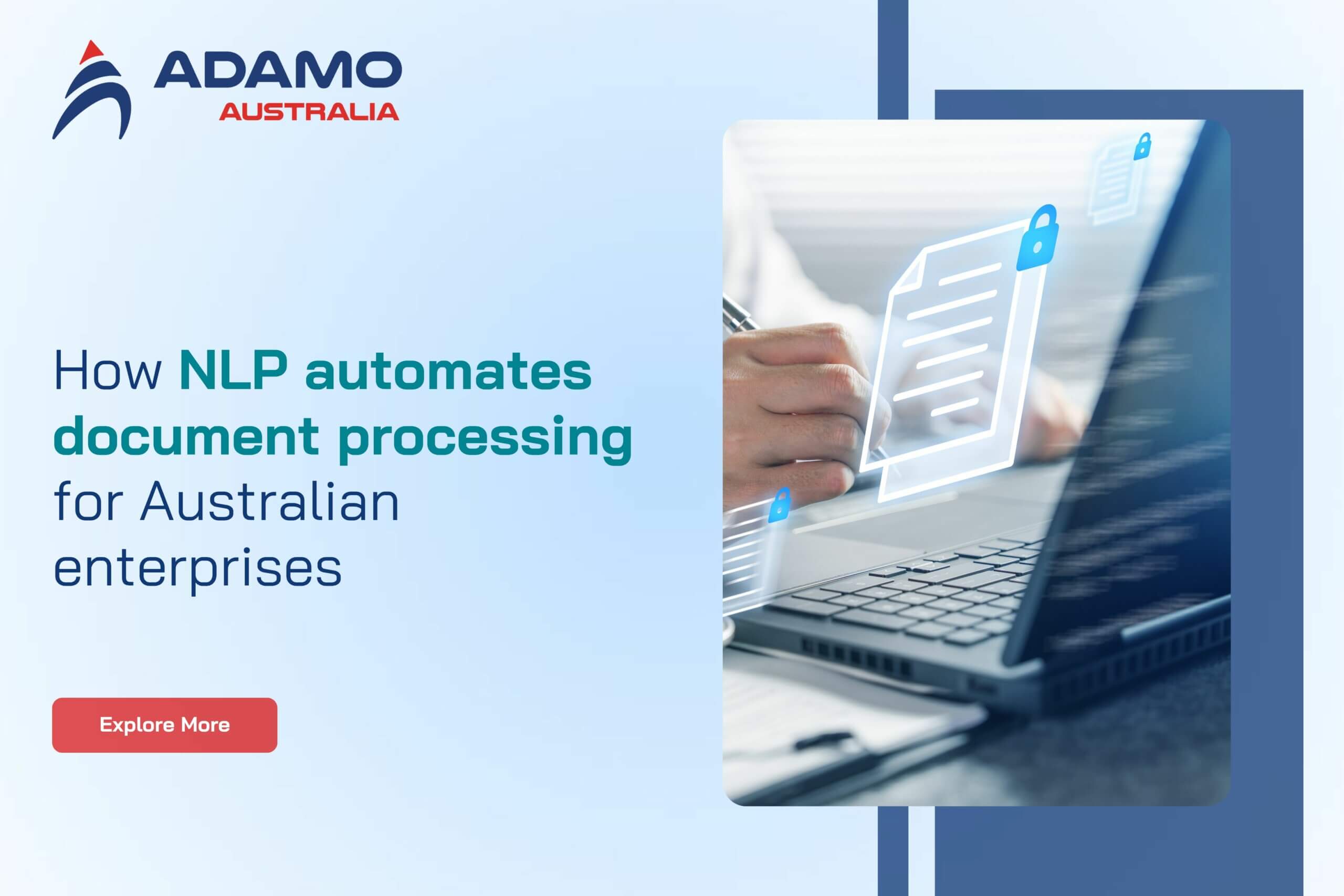
NLP automates document classification, entity extraction, and text analysis for Australian enterprises. Real use cases in government, insurance, HR, and travel.
Description: The global NLP market reached USD 36.8 billion in 2025 and is projected to grow to USD 193.4 billion by 2034 at a CAGR of 19.7%. For Australian enterprises and government agencies processing millions of documents, emails, and support queries annually, NLP automates the tasks that consume the most staff time: classifying documents, extracting entities, analysing sentiment, summarising reports, and routing enquiries. This article covers five core NLP capabilities, how Adamo Software applies them in production systems, and what Australian organisations should consider before building custom NLP solutions.
The global natural language processing market reached USD 36.8 billion in 2025 and is projected to grow to USD 193.4 billion by 2034, at a compound annual growth rate of 19.7% (Fortune Business Insights, 2025). Text analytics leads NLP applications at 31.8% market share, driven by the growing volume of unstructured text data that businesses must process: emails, contracts, support tickets, clinical notes, regulatory filings, and social media feedback.
For Australian enterprises and government agencies, the scale of this challenge is significant. A mid-sized insurance company processes thousands of claim documents weekly. A government department receives tens of thousands of citizen enquiries per month. A healthcare provider generates clinical notes for every patient encounter. Each of these text-heavy workflows traditionally requires humans to read, interpret, classify, and act on the content. NLP automates these steps by enabling machines to understand human language at scale.
Adamo Software Australia builds custom NLP solutions that go beyond generic text processing. Each system is trained on the client’s domain vocabulary, document formats, and business logic, producing outputs that integrate directly into operational platforms rather than generating standalone reports.
Key Takeaways:
- The global NLP market reached USD 36.8 billion in 2025, projected to reach USD 193.4 billion by 2034, CAGR 19.7% (Fortune Business Insights)
- Healthcare NLP is growing at 24.34% CAGR, the fastest among all verticals (Mordor Intelligence, 2026)
- NLP reduces manual text processing effort by over 60% in enterprise supply chain applications (Technavio, 2026)
- Adamo Software applies NLP in production across chatbot intent detection, document entity extraction, CV summarisation, SQL generation from natural language, and travel query understanding
- Australian government agencies are deploying NLP for policy document processing, citizen enquiry routing, and regulatory compliance monitoring
Five Core NLP Capabilities for Australian Organisations
Document Classification and Routing
Document classification assigns incoming documents to predefined categories based on their content. An insurance company might classify incoming documents as new claims, supporting evidence, appeals, or correspondence. A government agency might classify citizen submissions as complaints, information requests, feedback, or statutory applications.
NLP classification models analyse the full text of each document, not just keywords, to determine the correct category. This distinction matters because keyword-based systems fail when documents use unexpected terminology or when the same keyword appears in multiple contexts. A machine learning classifier trained on the organisation’s actual document corpus achieves consistently higher accuracy than rule-based approaches.
Adamo Software’s enterprise internal chatbot uses NLP classification as its first processing step. When an employee sends a query, the NLP layer identifies the request type (HR task, automation request, communication task, or reporting query) and routes it to the appropriate processing pipeline. This classification happens in milliseconds, enabling the chatbot to handle diverse request types through a single conversational interface.
Named Entity Recognition and Data Extraction
Named entity recognition (NER) identifies and extracts specific data elements from unstructured text: people’s names, company names, dates, monetary amounts, addresses, medical terms, product codes, and policy numbers. NER transforms free-form text into structured data that can be stored in databases, validated against business rules, and used for downstream analysis.
Adamo Software applies NER in combination with OCR for the insurance document processing system. After optical character recognition extracts raw text from scanned documents, NER models identify specific entities: the claimant’s name, policy number, claim amount, date of incident, and type of loss. These extracted entities are validated against the insurer’s database before being entered into the claims management system. The combined OCR and NER pipeline reduced data entry errors by 40%.
For Australian government agencies processing applications, permits, and regulatory submissions, NER extracts the critical data points (applicant details, property addresses, reference numbers, compliance dates) from forms and supporting documents, eliminating manual data entry for routine submissions.
Sentiment Analysis and Feedback Processing
Sentiment analysis determines the emotional tone of text: positive, negative, neutral, or mixed. For Australian businesses processing customer feedback at scale, sentiment analysis provides a real-time pulse on customer satisfaction without requiring humans to read every comment.
Practical applications include monitoring product reviews across e-commerce platforms to detect emerging quality issues, analysing support ticket language to identify at-risk customers before they churn, processing employee survey responses to surface workplace concerns, and tracking social media mentions to measure brand perception shifts after product launches or service changes.
The value of sentiment analysis scales with volume. A business processing 50 customer emails per day can have humans read them all. A business processing 5,000 customer interactions per day across email, chat, social media, and reviews needs automated sentiment detection to prioritise which interactions require human attention.
Text Summarisation and Report Generation
Large language models have made text summarisation dramatically more capable since 2023. NLP summarisation systems condense long documents (contracts, research papers, meeting transcripts, clinical notes, legislative texts) into structured summaries that highlight key points, decisions, and action items.
Adamo Software’s enterprise chatbot includes NLP-powered summarisation as a core feature. The system summarises CVs into standardised formats that highlight relevant experience, skills, and qualifications for specific job descriptions. The result: HR staff spend seconds reviewing a structured summary instead of minutes reading a full CV, contributing to the 50% reduction in recruitment processing time.
For Australian government agencies processing policy documents, legislation reviews, and consultation submissions, NLP summarisation converts hundreds of pages of input into actionable briefing documents that decision-makers can review efficiently. Healthcare providers use similar capabilities to summarise patient histories from clinical notes spread across multiple visits and systems.
Natural Language Query and SQL Generation
Perhaps the most commercially impactful NLP capability for enterprise adoption is the ability to query data using natural language instead of writing code. Employees who lack SQL skills can ask questions like “show me total sales by region for the last quarter” and receive accurate database queries and formatted results.
Adamo Software built this capability into the enterprise internal chatbot. The system generates SQL queries from natural language requests, allowing employees to pull KPI reports, analyse datasets, and generate Excel automation code by describing what they need in plain English. This reduced manual data analysis time by 70% because employees no longer needed to wait for a data analyst to write and run queries on their behalf.
SAP and Anthropic’s January 2025 partnership to embed advanced NLP reasoning into ERP solutions confirms that natural language data querying is becoming a standard enterprise expectation, not a niche feature. Australian organisations that implement this capability early gain an operational advantage by democratising data access across non-technical teams.
NLP Applications by Australian Industry
Government and Public Sector
Australian government agencies are among the most active NLP adopters. Transport for NSW announced plans to trial an internal generative AI chatbot for managing complex staff queries and document generation. The Council of Small Business Organisations Australia (COSBOA) launched Small Business PEAK, a government-backed chatbot funded through a AUD 60 million federal program, to assist small businesses in understanding industrial relations reforms. The National AI Centre tracks NLP adoption across government and provides guidance through its AI Adoption Tracker.
For government document processing, NLP handles citizen enquiry classification and routing, Freedom of Information (FOI) request triaging, policy submission analysis, and compliance document review. Each application reduces the manual processing burden on public servants while improving response times for citizens.
Insurance and Financial Services
The BFSI sector holds 21.10% of the global NLP market share (Mordor Intelligence, 2026). Australian insurers and financial institutions use NLP for claims document processing (extracting entities and classifying claim types), fraud detection (analysing claim narratives for inconsistencies), compliance monitoring (scanning communications for regulatory violations), and customer service automation (routing and responding to enquiries).
Adamo Software’s insurance OCR solution incorporates NLP at every stage: text extraction, entity recognition, data validation, and anomaly detection. The system processes both typed and handwritten text, verifying extracted information against business rules before integration into the claims database.
Healthcare
Healthcare NLP is growing at 24.34% CAGR, the fastest among all industry verticals (Mordor Intelligence, 2026). In Australia, where the healthcare sector is worth approximately $270 billion annually, NLP applications include clinical note processing (extracting diagnoses, medications, and procedures from free-text notes), medical coding automation (assigning ICD-10 codes from clinical documentation), referral letter analysis (extracting key information for specialist triage), and patient feedback analysis (monitoring satisfaction trends across facilities).
The CHECK framework recently demonstrated that clinical NLP models can reduce hallucination rates from 31% to 0.3%, opening a path for compliance-ready NLP deployment in high-risk healthcare settings (Mordor Intelligence, 2026). For Australian healthcare organisations operating under TGA guidelines, this level of accuracy validation is a prerequisite for production deployment.
Travel and Hospitality
NLP powers the conversational layer of travel technology platforms. Adamo Software built an AI-powered travel assistant that uses NLP to understand natural language tour queries (“I want a family-friendly beach holiday in Queensland under $3,000 for five nights”), match them against structured CMS inventory data, and present relevant options with pricing. The NLP component handles intent detection (the user wants to book a tour), entity extraction (family-friendly, beach, Queensland, $3,000 budget, five nights), and response generation (presenting matched results in conversational format).
Building vs Buying NLP Solutions
Australian organisations evaluating NLP have three paths available.
Off-the-shelf NLP APIs (Google Cloud Natural Language, AWS Comprehend, Azure Cognitive Services) provide pre-built models for sentiment analysis, entity recognition, and language detection. These work well for generic use cases where no domain-specific vocabulary or document formats are involved. Costs are usage-based, typically AUD 1-5 per 1,000 API calls.
Fine-tuned models start with a pre-trained base (such as an open-source LLM) and are further trained on the organisation’s own data to improve accuracy on domain-specific terminology and document types. This is the approach Adamo Software uses for most enterprise NLP projects. Development costs range from AUD 40,000 to AUD 150,000, depending on the complexity of the domain and the volume of training data required.
Fully custom NLP pipelines are built from the ground up for organisations with unique requirements that cannot be met by fine-tuning existing models. These are rare and typically involve regulated industries (healthcare, defence, government) where data sovereignty, model explainability, and audit trails are non-negotiable. Development costs exceed AUD 150,000 and require ongoing model management.
For most Australian enterprises and government agencies, the fine-tuned approach delivers the best balance of accuracy, cost, and time to deployment. Adamo Software’s AI development services cover all three paths, with a structured assessment process that recommends the right approach based on the client’s data, accuracy requirements, and compliance obligations.
Conclusion
NLP is the AI capability that directly addresses Australia’s largest productivity drag: the volume of unstructured text that humans must read, interpret, classify, and act on every day. The market is growing at 19.7% annually because the economics are clear: NLP reduces manual text processing effort by over 60% in enterprise applications, and healthcare NLP is accelerating at 24.34% CAGR as clinical documentation demands intensify. Adamo Software’s production NLP deployments demonstrate what these numbers mean in practice: an internal chatbot that classifies requests, summarises CVs, and generates SQL queries cut recruitment time by 50% and data analysis time by 70%. An insurance document pipeline that combines OCR with NER reduced errors by 40%. These are not research prototypes. They are operational systems processing real business data every day.
Automate Text Processing with Custom NLP Solutions from Adamo
Australian organisations process millions of documents, emails, and enquiries every year. Adamo Software Australia builds custom NLP systems that classify, extract, summarise, and analyse text at scale, integrated directly into your CRM, document management, and operational platforms. From government document routing to insurance claims processing and healthcare clinical notes, our engineering team delivers NLP solutions trained on your data and built for your compliance requirements.
Explore our AI Development Services: {DOMAIN}/ai-ml-software-development/
Contact us for a free consultation: {DOMAIN}/contact/

 adamosoft.com
 (+84) 373 11 44 88